
Disclosure: This post contains affiliate links. If you book through one of these links, I may earn a commission at no extra cost to you.
Planning a trip? Get our free Travel Planning Checklist:
Santorini is the rare destination that lives up to its photos — and then rearranges your plans anyway. The caldera at golden hour, the blue domes of Oia stacked over the Aegean, the black-sand beaches, a Minoan city buried by the same eruption that created the whole island: three days is just enough to do it justice if you plan the days in the right order.
This itinerary is built for first-timers. It assumes you arrive the morning of Day 1 and leave on the evening of Day 3 or the morning after — and it strings the island’s greatest hits together in a route that minimizes backtracking: the caldera towns on Day 1, the ancient south on Day 2, and the water on Day 3. For a longer trip, it’s also a natural partner to other Europe itineraries — see my Lisbon in 3 Days and Iceland’s Ring Road in 7 Days guides for more trip ideas.
When to visit (and how to get there)
The sweet spot is May–June and September–early October: warm water, long evenings, and prices that run roughly 40–50% below August. July and August are the hottest, busiest, and windiest months — the meltemi winds pick up on summer afternoons, which can be refreshing but makes for choppy ferry rides.
Most visitors arrive either by air or by ferry. Santorini National Airport (JTR) is about a 20-minute bus ride from Fira, and direct flights from Athens take around 45–55 minutes. The ferry from Piraeus, Athens’ port, is the classic arrival: high-speed services take around 5–6 hours, conventional ferries 6–9, with several departures a day in summer. If the ferry fits your schedule, take it — sailing into the caldera for the first time, with the cliffs rising 300 meters out of the sea, is one of the great arrivals in Europe.
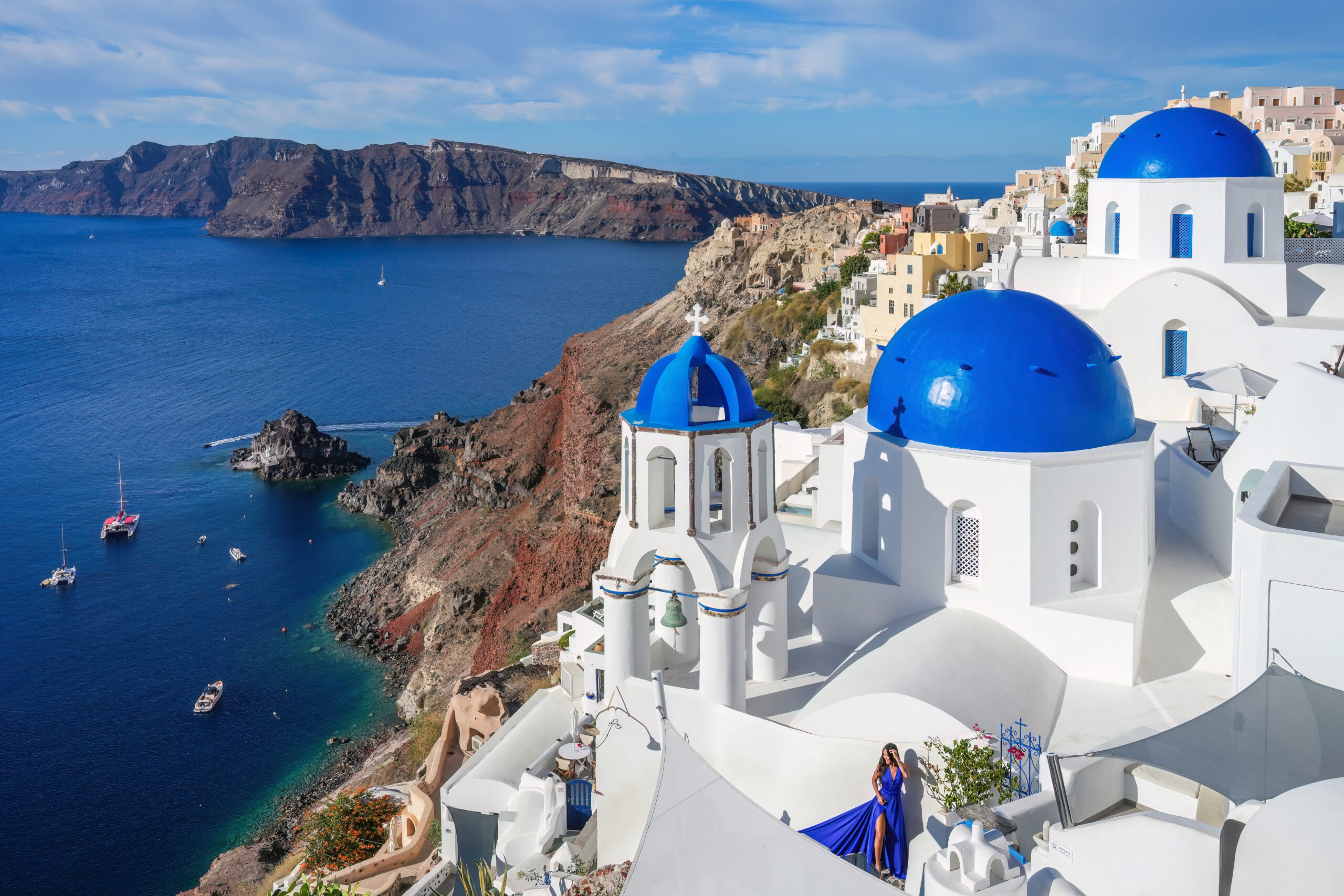
The blue domes of Oia above the caldera, Santorini. Photo: Giles Laurent, CC BY-SA 4.0, via Wikimedia Commons
Where to base yourself
The three caldera towns each suit a different kind of trip:
- Fira is the island capital and the transport hub — all the island’s KTEL buses leave from here, and it’s where you’ll find the most restaurants, shops, and nightlife. It’s also the busiest, since cruise-ship tenders land here. Best base for first-timers without a car.
- Oia, pronounced “ee-ah,” is the postcard village at the island’s northern tip: blue domes, cave hotels, the famous sunset. It’s the prettiest and most expensive of the three, and the least convenient for getting around.
- Imerovigli sits between them on the caldera path — quieter, with luxury hotels and private terraces, and arguably the best caldera and sunset views on the island thanks to its higher elevation. Fewer restaurants and shops, though.
First-timer default: Fira for convenience, Imerovigli for romance, Oia if the view matters more than the logistics.
Day 1: Fira, the caldera hike, and sunset in Oia
Arrive in the morning, drop your bags, and spend the first part of the day in Fira. The town clings to the caldera’s edge 260 meters above the sea; wander the pedestrian lanes, visit the Museum of Prehistoric Thera if you want context for tomorrow’s Akrotiri visit, and have lunch somewhere with a caldera view — you’ll pay a premium, but on day one it’s worth it.
The afternoon is for the island’s signature walk: the caldera hike from Fira to Oia, about 10 km (6 miles) along the crater rim through Firostefani and Imerovigli. It’s rocky and unshaded, so bring water and real shoes — and time it right. Start in the mid-afternoon and you’ll arrive in Oia for sunset, which is the classic way to do it.
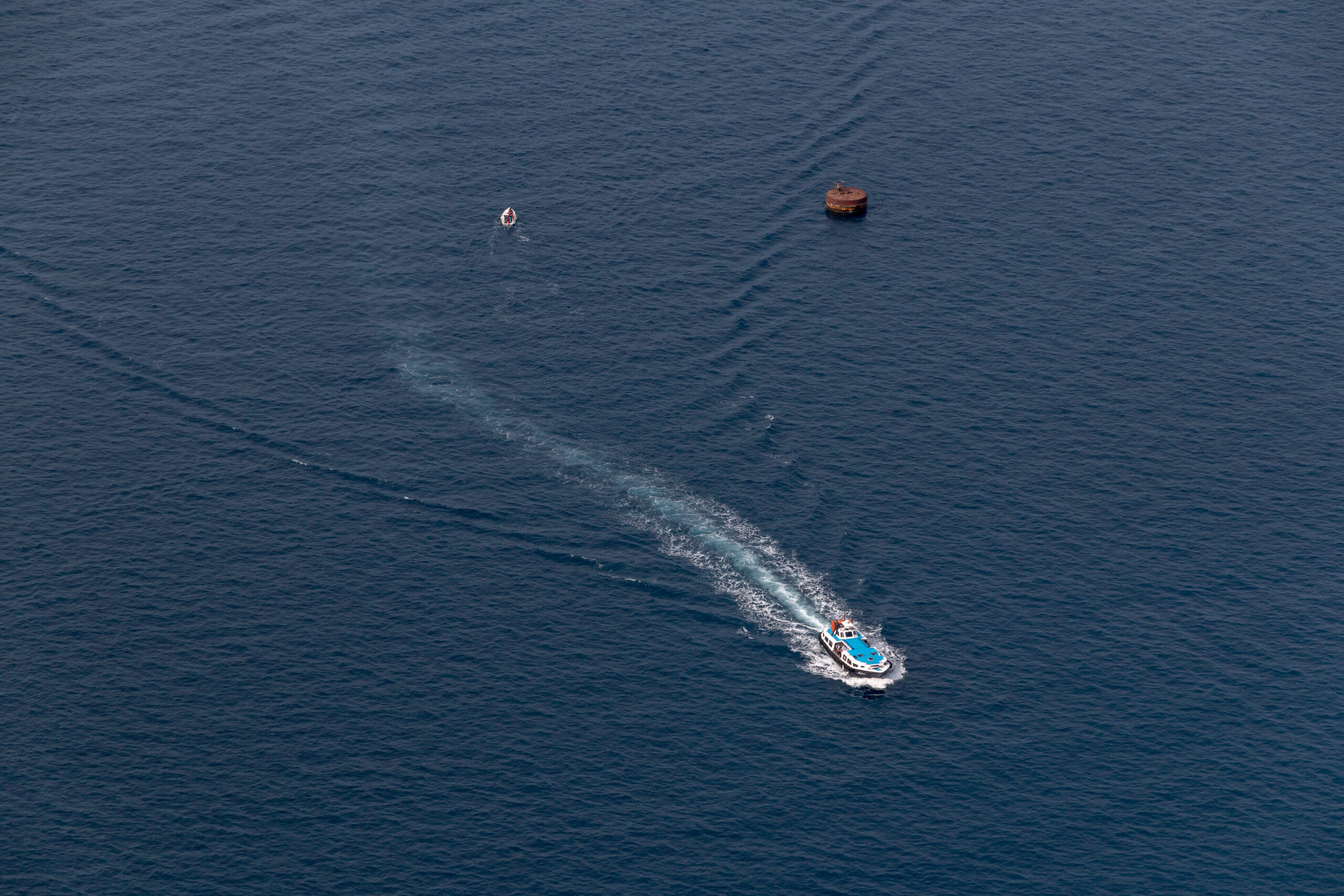
Fira and the caldera, Santorini. Photo: Dietmar Rabich, CC BY-SA 4.0, via Wikimedia Commons
The Oia sunset, honestly: the famous Castle of Oia viewpoint — the ruins of a Venetian-era castle largely destroyed in the 1956 earthquake — fills up solid. It has been known to be full an hour before sunset in high season. Go early and stake out a spot, or skip the crush: the windmills at the village’s northern end, a caldera-view restaurant reservation, or Ammoudi Bay 300 steep steps below all give you the same sun with a fraction of the elbows. In the morning, do the opposite — wander Oia before about 10am, when the tour buses arrive and the lanes turn into a queue.
Stay in Oia for dinner — grilled octopus and Assyrtiko wine with the caldera glowing in the dark is a fine first evening — then take the bus back to Fira (buses thin out in the evening, so check the return schedule before you go).
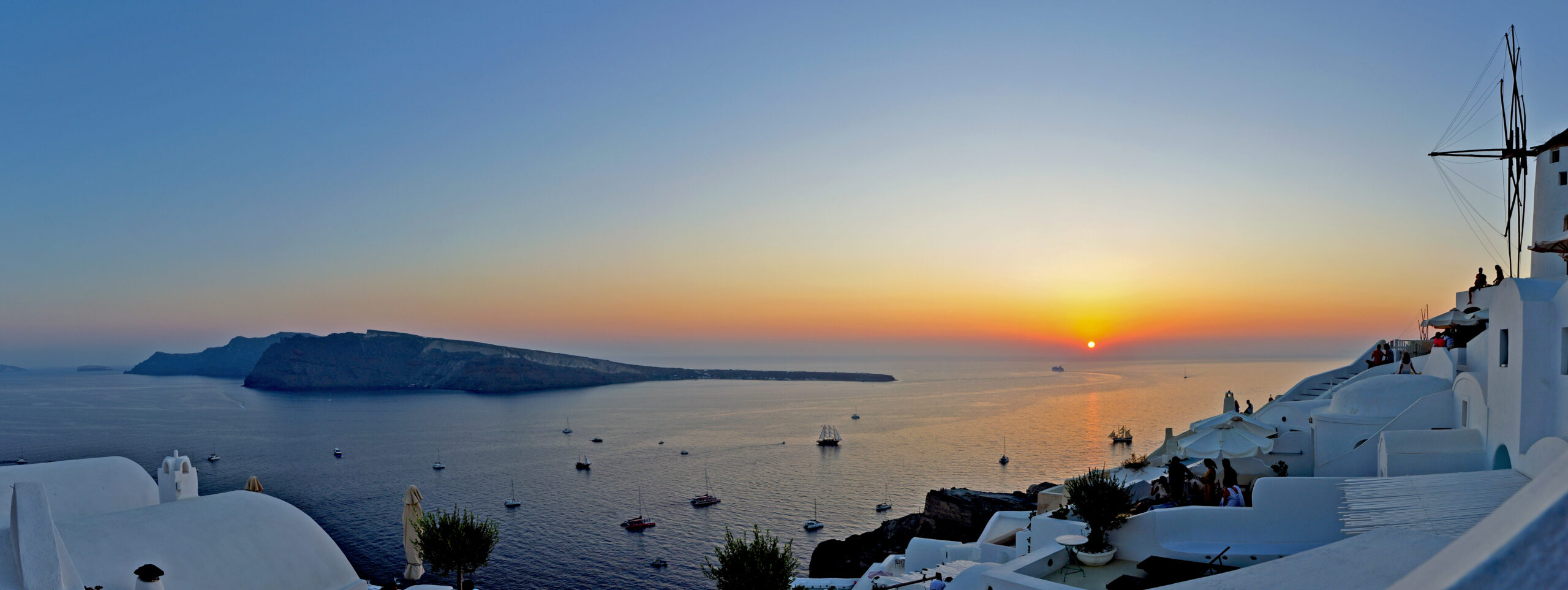
Sunset over Oia, Santorini. Photo: Sidvics, CC BY-SA 4.0, via Wikimedia Commons
Day 2: Akrotiri, the red cliffs, and black-sand beaches
Day 2 heads south to the island’s ancient heart. Start early at Akrotiri, the prehistoric town buried by the Theran eruption around 1600 BC — the “Pompeii of the Aegean.” What you’ll walk through is genuinely astonishing: multi-story buildings, frescoes, and an advanced drainage system, all preserved under meters of volcanic ash and now sheltered under a modern protective roof. Arrive before the midday heat and the tour buses.
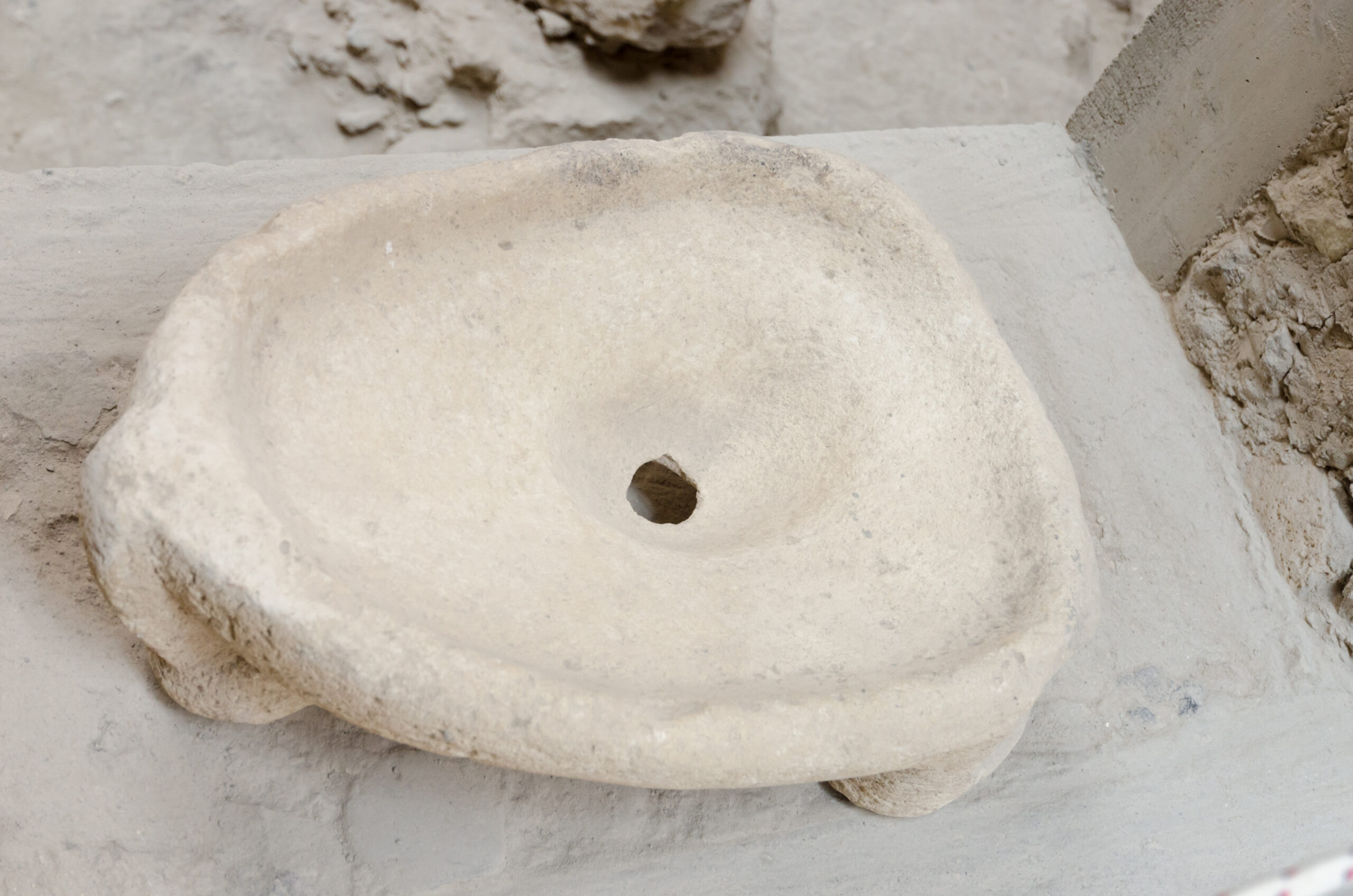
The excavated streets of the Akrotiri archaeological site, Santorini. Photo: Norbert Nagel, CC BY-SA 3.0, via Wikimedia Commons
Nearby, Red Beach is one of Santorini’s most photographed spots — dramatic rust-red volcanic cliffs dropping into the sea. A note of honest advice: the Municipality of Thira’s ban on bathers remains in force here due to landslide risk, and rockfalls have injured people. Treat it as a viewpoint (the clifftop above gives the best angle anyway) or see it from the water, and do your swimming elsewhere.
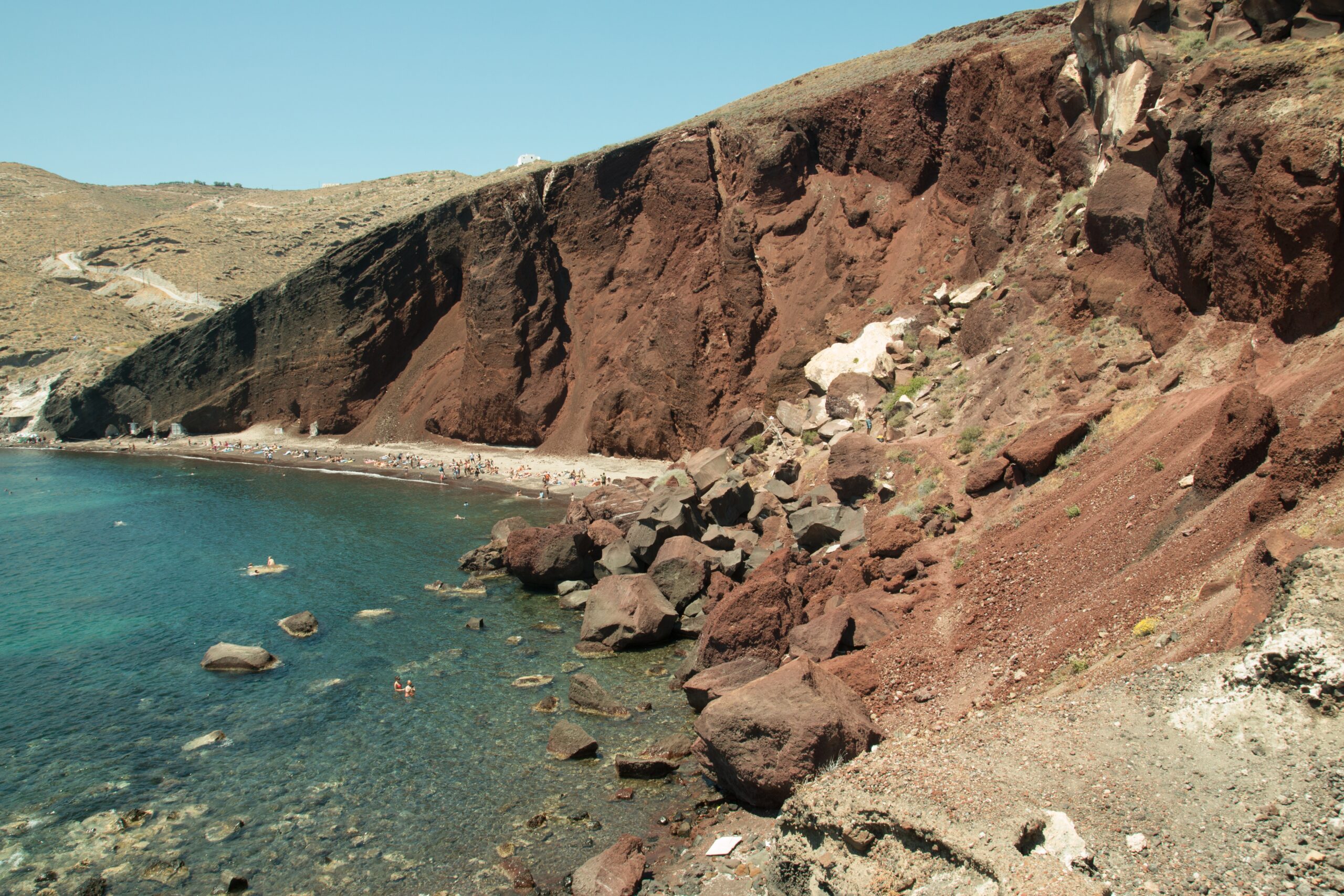
Red Beach, Santorini. Photo: Zde, CC BY-SA 4.0, via Wikimedia Commons
For actual beach time, the island’s black-sand beaches are the move: Kamari for an organized, family-friendly promenade, or Perissa and Perivolos for beach clubs and a younger crowd. Fair warning — volcanic sand burns by midday, so wear sandals.
End the day at Santo Wines, the island’s landmark winery: a co-op founded in 1947 with some 1,200 member-growers. Book the sunset tasting on the caldera-edge terrace and taste Assyrtiko, the crisp, mineral indigenous white grown in low basket-shaped vines (kouloura) to survive the wind, plus the dessert wine Vinsanto, aged in oak for a minimum of two years. It’s the best-value sunset on the island — all the caldera glow, none of the Oia crowds.
Day 3: The caldera by water, then Ammoudi Bay
You can’t really say you’ve seen Santorini until you’ve seen it from the water — the cliffs make no sense from above the way they do from sea level. Day 3 belongs to a catamaran cruise around the caldera. The typical five-hour sailing includes a swim stop in the sulfur-rich hot springs at Palea Kameni (wear a dark swimsuit — the iron-rich water stains light fabric), a stop at Red Beach and White Beach, snorkeling gear, a Greek meal cooked onboard, and local wine and beer. Most operators include hotel pickup and drop-off, and the smaller boats (15–20 guests) feel like a world apart from the big ones.
Two well-reviewed options to compare: this romantic sunset catamaran cruise with meal and drinks (4.7 stars from 350+ reviews, hotel transfers included), and this half-day caldera catamaran cruise with food and drinks (4.8 stars from 1,700+ reviews, morning or sunset departures). The sunset sailing pairs perfectly with this itinerary’s finale.
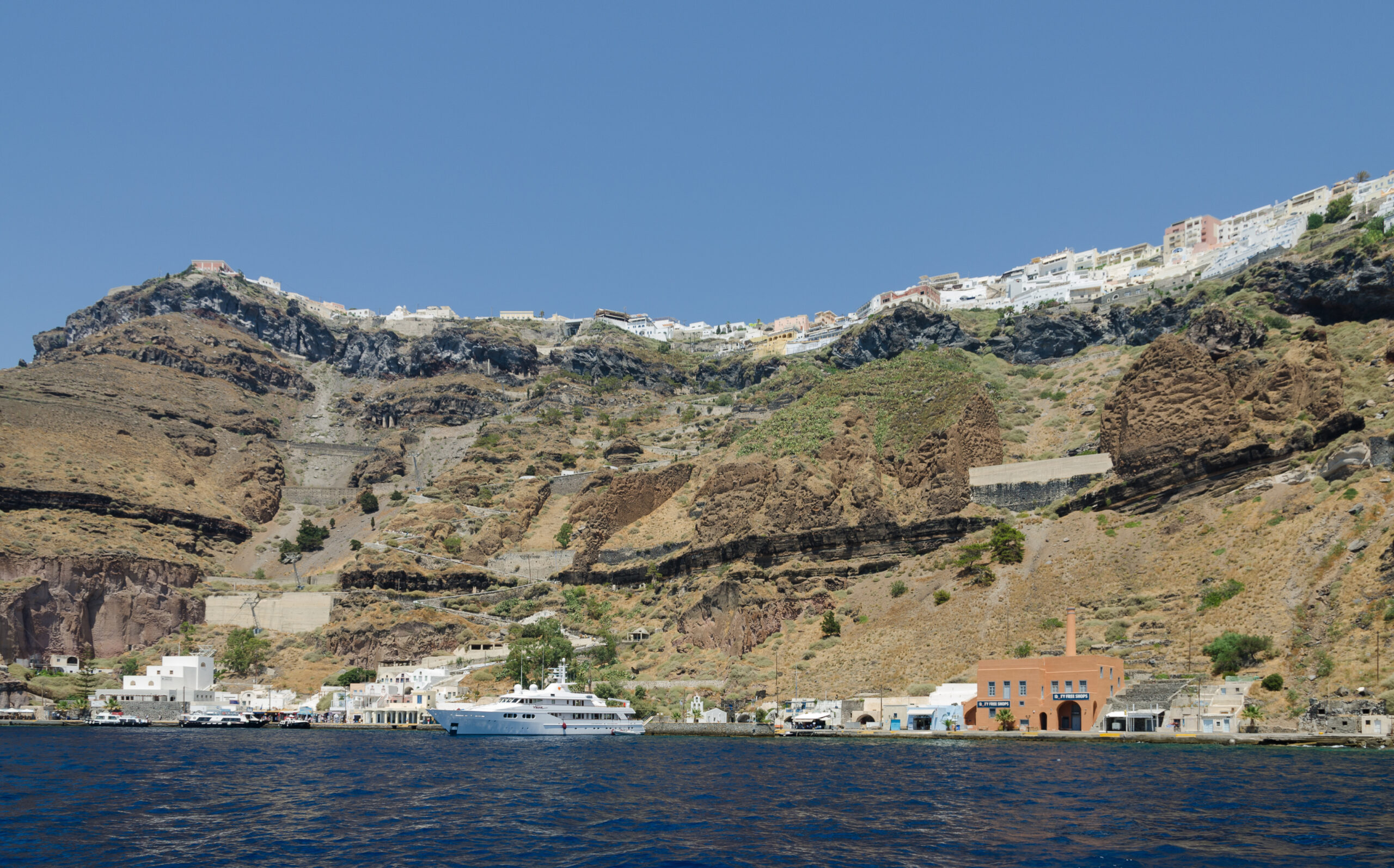
Fira and the caldera rim seen from the water, Santorini. Photo: Norbert Nagel, CC BY-SA 3.0, via Wikimedia Commons
Back on land, finish at Ammoudi Bay, the little port tucked under Oia’s cliffs at the bottom of around 300 steep steps. Come down late afternoon for a swim off the rocks, then claim a table at one of the waterfront seafood tavernas and watch the sun drop into the Aegean — no reservation warfare required. If you took the morning cruise, this is your sunset; if you took the sunset sailing, this is your dinner.
Practical tips for three days in Santorini
- Buses: KTEL buses run from Fira to the main villages, the airport (€2), and Athinios port (€2.50). Cash on board, exact change helps, and buses get sparse in the evening — don’t get stranded in Oia.
- Taxis are scarce — roughly 30 on the whole island — so don’t count on hailing one at peak times. Pre-book airport transfers.
- The cable car (Fira to the old port, €6 adult one-way) is a 3-minute ride with long queues when cruise ships tender. The alternative is around 588 steps — bring water.
- Cruise-ship crowds peak midday; Oia is at its worst when ships are in port, and at its best before 10am. Greece has introduced a peak-season cruise passenger levy for Santorini — one more reason the shoulder seasons are sweet.
- Budget: island costs run high by Greek standards — figure on €25–40 for a good taverna dinner, more with a caldera view. A shared catamaran cruise typically runs around €110–160 per person in high season.
- Water: Santorini’s supply system strains under summer demand, with desalination doing the heavy lifting. Keep showers short and reuse towels — the island will thank you.
- Earthquake worries? The early-2025 seismic swarm was declared over by Greek seismologists in February 2025, and tourism has been fully normal through 2026. Nothing to plan around.
The bottom line
Three days in Santorini gives you the caldera from above on the hike, from below on the cruise, and from within at Oia and Ammoudi Bay — plus a 3,600-year-old city and the island’s best wine. It’s a lot of ground, but the island is small enough (roughly 25 km long) that you can sleep in the same bed all three nights and still see it all. Book the catamaran and the winery tasting ahead for summer trips, build in one slow morning, and let the island do the rest.